



Authorized LiftMaster Dealer in San Francisco for Gate Install and Repair
If your property has an automatic gate, your local fire department may require a Knox device before they sign off on the install. A Knox Box or Knox Key Switch gives firefighters a fast, controlled way in during an emergency. You never hold the key. Only the fire department does. Here is how the system works, which version fits your gate, and what the whole process looks like from order to inspection.
What Is a Knox Box / Knox Rapid Access System?
A Knox Box is part of the Knox Rapid Access System. Fire departments and other emergency services across the U.S. use it to reach buildings, gates, parking structures, gated communities, and private homes when seconds count.
The point is simple. Get the fire department inside fast, safely, without smashing the gate or cutting a chain. When an automatic gate goes through a city permit, an inspection, or a fire department review, Knox often becomes a condition of approval.
What gets required depends on the site. Sometimes it is a standard Knox Box. Sometimes a Knox Key Switch, a Knox Padlock, or another approved Knox device. Your local fire department, the authority having jurisdiction, makes that call.
Why does it matter? Picture the scenarios where access can't wait:
- Structure fire
- Medical call
- Alarm activation
- Gas leak
- Emergency police or fire response
- Access to a fire riser room, electrical room, or other critical area

Locked gate, keypad, card reader, no responder access. That is the problem Knox solves.
Who Makes Knox Boxes?
One company makes them. The Knox Company, legally Knox Associates, Inc., doing business as The Knox Company. Headquarters and manufacturing sit in Phoenix, Arizona, not California. The company has built these products since 1975.
This is a patented, proprietary system. A random California shop can't fabricate a Knox Box and call it the same thing. That is also why a hardware-store lockbox is not an accepted substitute. The fire department's master key only fits genuine Knox cores.
California still has a clean path to get one. Product is ordered through the Knox system, tied to your address and your fire jurisdiction. Installation runs through local licensed contractors and Knox Trusted Partners (KTP), installers Knox has vetted and trained. Manufacturing is centralized in Arizona. The hands-on work happens here, on your driveway.
That split is where a local gate contractor earns their keep. Someone has to match the device to the right jurisdiction, order it correctly, and wire it to your operator the right way.
Why Fire Departments Require Knox Access
No access means forced access. Firefighters will cut the chain, pry the gate, or break the lock to get through. That is real damage to your property, and it happens in minutes.
Knox flips that. The responder uses an authorized fire department key, opens the box or turns the switch, and gets in clean. No cut metal. No shattered hardware. No bill for a destroyed gate operator afterward.
Who Holds the Knox Key?
This part trips people up, so be clear about it.
The installer does not hold the Knox key. The property owner usually does not hold it either. The key lives with the local fire department, the emergency services, the authority having jurisdiction.
Our company can order, install, and connect a Knox Box or Knox Key Switch. We never receive the fire department master key. Each fire jurisdiction runs its own keyway and master key system. That is deliberate. It stops a contractor, a homeowner, or a stranger from ever popping the box open.
Short version: we build the system, the fire department keeps the key.
How the Keyway Works by Jurisdiction / ZIP Code
The device is locked to your installation address and to the fire department that serves it. ZIP code is a handy reference point, nothing more. The real driver is jurisdiction.
Why split the hair? One ZIP can be served by a single fire agency. Other times, jurisdiction lines run right between neighborhoods. Two homes a block apart can answer to different responding agencies. So the precise statement is this. The keyway follows the local fire department jurisdiction, with ZIP code as a practical guide.
How You Actually Order a Knox Box (Address-Locked Process)
You can't grab one off a shelf at a building-supply store. The box is built around the specific lock core for your city. Here is the flow:
- Pick your department. Go to the official site, knoxbox.com, and enter your ZIP code or your fire agency by name. Mountain View Fire Department, Palo Alto Fire Department, Santa Clara County Fire, whichever serves your address.
- Lock in the code. The system pulls the unique lock code for your area automatically. Skip this and the order stalls. The Arizona factory has to know which lock core to drop into your box, the one that opens to your department's master key.
- Pay. Choose a model, surface-mount or recessed (wall-embedded), and check out. If your department requires sign-off first, the site notifies them automatically for agency approval.
How the Knox Box Arrives (Delivery & Initial State)
The genuine Knox Box ships by mail, usually UPS or FedEx, straight to your site or office. It comes direct from the Arizona plant. No fire department hand-off on delivery.
It shows up open. No key inside. The door is either removed or propped ajar.
Knox Box vs. Knox Key Switch: The Core Difference
Same goal, two very different devices. This table sorts them fast.
| Knox Box | Knox Key Switch | |
|---|---|---|
| What it is | A secure, lockable box | A key cylinder wired to a switch |
| Stores keys / cards? | Yes | No |
| Connects to gate operator? | Optional (via relay) | Always |
| How it works | Open the box, grab the keys | Turn the key, the gate opens |
| Typical use | Commercial buildings | Residential automatic gates |
Two devices, but not a strict either-or. Knox also makes a Gate Box with Gate Switch, a hybrid that combines both in one housing. Turn the key to open the gate, and still keep physical keys stored inside for whatever else responders need. Handy when a site wants gate access and key storage at the same point.
Knox Box (The Classic)
A secure box mounts to a wall, a post, a pedestal, a gooseneck, or a gate column. It opens only with the fire department's Knox master key. Inside you might find gate keys, building keys, mechanical and electrical room keys, fire riser room keys, elevator keys, access cards, remotes, fobs, written codes, emergency contacts, or site plans.
Good fit for commercial buildings, apartments, gated communities, parking garages, HOA properties, and any site with multiple access points or manual gates.
Knox Box With Relay
Some boxes carry an electrical contact, a relay. The firefighter inserts the Knox key and turns it. That motion does two things. It opens the box, and it fires the contact.
Wire that contact to a gate operator, an electric strike, a mag lock, an access panel, or a door operator, and the same turn that opens the box also sends the open command. Keys for the rest of the building can still sit inside for everything else.
Knox Gate & Key Switch
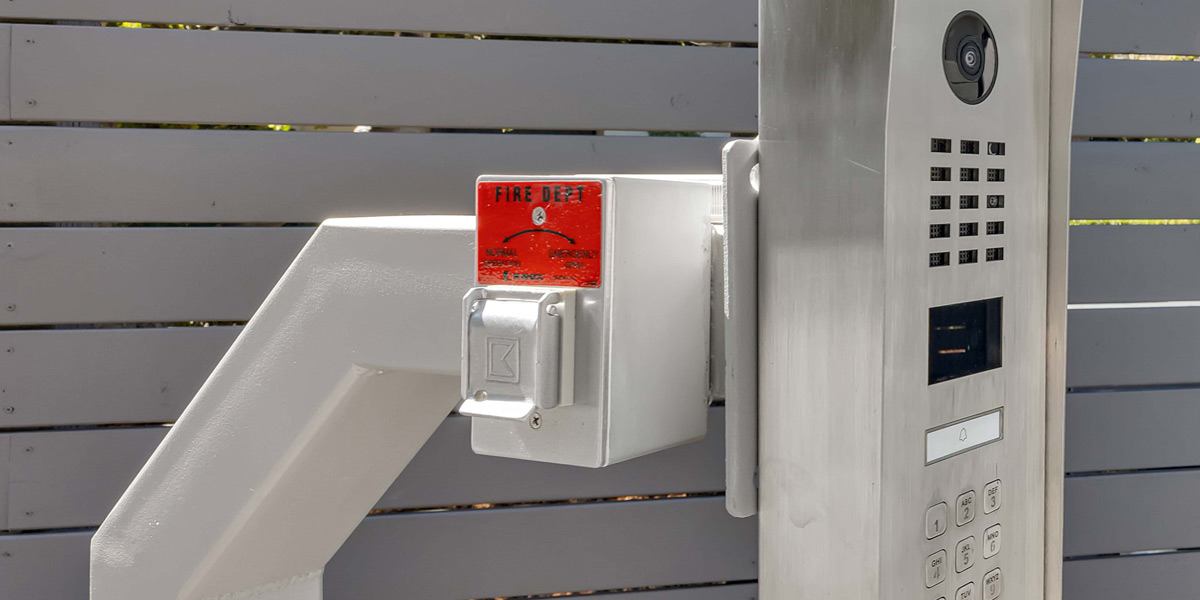
Knox calls this one the Knox Gate & Key Switch, the device you want for an electric gate. Different animal from the box. Not storage. There is no room inside for spare keys, fobs, or cards. It is a secure key cylinder, a Medeco-style keyway, mounted in a small housing, on a post, a column, a gooseneck, or beside the operator.
The cylinder only turns for the local fire department's Knox key. Wires run from the switch to the gate operator, typically to an open command, a fire department input, an access control input, or a dry contact. Turn the key, the contact makes or breaks, the operator gets the signal, the gate rolls open.
Two flavors exist. A mechanical key switch, and an eLock electronic version. Both do the same job at the gate. Your installer and the fire department pick the one that fits your operator and the jurisdiction's preference.
How it plays out in the field:
- A firefighter pulls up to the automatic gate.
- Spots the Knox Key Switch on the post or by the operator.
- Inserts the fire department Knox key.
- Turns it.
- The switch sends the open signal to the gate motor.
- The gate opens.
No box to open. No physical keys to dig out. Just an electrical switch that opens the gate. That is why so many residential automatic gates use it. The department usually just needs the gate open, not a ring of keys.
Which One Do You Need? Residential vs. Commercial
Read the three cases below and you'll know which camp you're in.
Private home with an automatic gate. Usually a Knox Key Switch. The fire department rarely needs a full key set for a single residence. They need the driveway gate open so they can reach the house. Mount the switch by the gate, wire it to the operator, done. Some departments still ask for a box. Most are fine with a key switch when it meets local rules.
Commercial, HOA, apartments, parking, gated community. Usually a full Knox Box. Responders may need more than the gate. Lobby, fire riser room, electrical room, elevator room, mechanical room, garage, roof access, utility areas. Several keys or access cards live in the box. If the site also runs an automatic gate, you might pair a relay-equipped box with the gate, or add a separate Knox Key Switch alongside it.
Knox splits boxes into two series, Commercial and Residential, and the commercial line scales by capacity. The KnoxBox 3200 holds up to 10 keys, fine for most buildings. The larger KnoxVault 4400 holds up to 50 keys plus access cards and emergency plans, built for big campuses and multi-point sites. Homes use the residential series. Businesses and large properties stay on the commercial side.
Installation Process, Step by Step
The full job runs in seven stages. The order matters.
- Check requirements. Where is the property? Which city or county? Which ZIP? Which fire department covers the address? Is there a permit? What does the inspector or fire marshal want? Which Knox product is approved for this jurisdiction?
- Pick the right product. Knox Box, Knox Gate & Key Switch, Knox Padlock, Knox Cabinet, or another approved device. Automatic gate usually means a key switch. For gates, Knox offers single and dual switch versions on a mounting plate (models 3502 and 3503), in mechanical or eLock form. Building, commercial, or manual access usually means a box.
- Order it. Placed through the Knox system, tied to the installation address and the local fire department. Some jurisdictions require department approval before the order ships.
- Install it. Mount the device where the fire department can see and reach it. Visible, accessible, near the gate or entrance, at an approved height, in a spot that satisfies local requirements.
- Wire it to the gate operator. The key switch lands on the operator's control board, usually a dry contact or open command. Turn the key, the contact activates, the operator opens the gate. Wire it so the gate opens reliably, safety devices keep working, and the setup stays UL 325 compliant.
- Test it. Confirm the switch is connected right. Gate opens on contact. Photo eyes, loops, and edges all operate. Emergency access works. The system behaves after activation.
- Coordinate with the fire department. Depending on jurisdiction, they may come to verify the install, lock the box, place keys inside, test the key switch, and approve it.
Remember the delivery state from earlier. The box arrives open and stays open through the build. Wiring, mounting, testing, all of it happens first. Only at the very end does the fire department close the box and set the keys. The installer never touches the master key.
Knox, UL 325, and Code Compliance
A legal automatic gate has to account for more than emergency access. UL 325 safety. Entrapment protection. Photo eyes. Safety edges. Loops. A properly configured operator. Local building code. Permit conditions. Fire department access.
Knox is the emergency-access piece. It does not replace safety devices. It does not override UL 325. It just hands the fire department a way to open the gate when they need to. A correct install carries both, safety and emergency access, together. (For a deeper look at gate and garage door safety law in California, see our related guide covering UL 325 and SB 969.)
Knox Box & Knox Key Switch: Frequently Asked Questions
What is a Knox Box?
A secure, tamper-resistant lock box that holds keys or access cards for emergency responders. Fire departments carry a master key that opens every Knox Box in their area, so they enter without breaking windows or doors.
How does a Knox Box work for a gate?
The box stores a gate key in a secure compartment, and a first responder uses the fire department key to unlock it and open the gate when needed. On automatic gates, a key switch is wired to the operator instead, so turning the key sends the open command.
Who makes Knox Boxes, and where are they made?
The Knox Company (Knox Associates, Inc.), based in Phoenix, Arizona. It is a patented, proprietary system, made by that one company since 1975.
Who has the key to a Knox Box?
The local fire department or emergency services. Not the installer, and usually not the property owner. Master keys are kept locked inside emergency apparatus, and on many systems an officer must enter a PIN to release the key, which logs who took it and when.
Can I get a copy of the Knox master key?
No. The Knox master key stays with the fire department, by design. Manufacturers guard the master key codes and will not release them to any other supplier, which keeps the system compatible and secure across a jurisdiction.
Why pay for Knox if I do not hold the key?
Because it lives on your property for compliance and emergency access. It protects your gate from forced-entry damage and gets responders in fast. The cost buys you a gate that survives the emergency instead of getting cut open.
What is the difference between a Knox Box and a Knox Key Switch?
A Knox Box is a lockable box that stores keys or cards. A Knox Key Switch stores nothing. It is a key cylinder wired to your gate operator. Open the box to grab keys. Turn the switch to open the gate.
Do I need a Knox Box or a Knox Key Switch for my automatic gate?
Usually a key switch. Fire and law enforcement reach a property through an electric gate by way of the Knox Gate Key Switch, which is wired into the gate. A residence rarely needs a full box of keys.
Manual gate or automatic gate, what is the difference for Knox?
Automatic gates usually take a Knox Key Switch wired to the operator. Manual gates usually take a Knox Box or a Knox Padlock with a physical key. A key switch needs a motor, so it makes no sense on a manual gate.
How much does a Knox Box cost?
A standard surface-mount commercial Knox Box runs roughly $400 to $650 depending on model and finish. Larger cabinet-style units for buildings with many keys can exceed $2,000. Recessed and tamper-alert versions cost a bit more.
Is a Knox device a recurring fee or a one-time purchase?
One time. A residential Knox Box and a Knox Gate Key Switch are each a one-time purchase with no monthly monitoring fee. Some jurisdictions add a separate annual permit, so check locally.
How do I order a Knox Box for my city?
At knoxbox.com. Enter your installation address or fire department, confirm it, and the system attaches the correct lock core for your jurisdiction. Pick a model, pay, and the order routes for agency approval if your department requires it.
Why can I not just buy a Knox Box at a hardware store?
The lock core is keyed to your specific fire jurisdiction. A generic lockbox will not open to the department master key, so it is not an accepted substitute when Knox is required.
Can I use a regular lockbox instead?
Generally no, not when the fire department requires Knox. Any system a fire department adopts must be compatible from one installation to the next, with a single master key that operates every lock box in the city.
Do I need a permit to install a Knox device?
Often, yes. Most local governments require fire department approval before installing a fire access box. In some areas a separate Knox permit is also required, renewed annually.
Who can install a Knox device?
A property owner or a licensed contractor can mount it. For an automatic gate, the key switch has to be wired into the operator correctly, which is where a gate contractor matters. It is the owner or contractor responsibility to verify the correct device and have it installed by final inspection.
Where should the Knox Box be mounted on a gate?
On the gate, or on a fence or wall within a few feet of it. Building boxes mount near the main entry, typically 5 to 6 feet off the ground, and gate boxes go on the gate or within 6 feet of it.
What gets stored inside a Knox Box?
Keys, access cards, key fobs, elevator keys, electrical shunt trips, or other vital information for responders. Each key should be tagged and grouped on a ring. A site map helps on large properties.
Does my building need keys stored too?
If responders need more than the gate, yes. A Knox Box opens and stores keys or access cards for lobbies, riser rooms, and electrical rooms. Some sites run both, a box for building access and a key switch for the automatic gate.
In what condition does the Knox Box arrive?
Open, with no key inside. Boxes ship to the property owner in the open position, and after install the owner contacts the fire department to schedule a lock-up. Do not close it early or you will lock yourself out.
How does the fire department secure the box after install?
You schedule a lock-up appointment. A fire official meets you on site to verify that every key works in its intended lock, then secures the box. This step is not a formality.
Does the gate stay open after a firefighter uses the switch?
It can be held open for the duration. The key switch lets responders hold the gate open during an event, then returns to normal so the keypad and opener run the gate again. Some jurisdictions require a minimum hold time.
Work With a Licensed Bay Area Gate Contractor
Knox is not an everyday device. It is not for homeowners, gardeners, delivery drivers, or contractors. It is emergency access for the fire department, used only when needed. You won't touch the key daily. Neither will we.
We install automatic gates and access control to code. UL 325, city requirements, permit conditions, fire department requirements, the full stack. When the fire department asks for Knox, we handle the whole path. Figure out which product you need. Check city and fire department rules. Order the right device, tied to the correct address and jurisdiction. Mount it. Wire the key switch to the gate operator. Confirm the gate opens on command. Prep the site for inspection. Coordinate between you, the inspector, and the fire department where needed.
One honest limit. We install and connect the system. We do not control the fire department master key, and neither does anyone outside the department. That boundary protects you.
Bay Area Lions Gate handles Knox end to end. Product selection, jurisdiction-correct ordering, mounting, operator wiring, testing, and inspection coordination, all under one licensed roof, across Palo Alto, Mountain View, San Jose, Santa Clara County, and the wider Bay Area. Planning an automatic gate, or stuck on a Knox requirement from your fire department? Call Bay Area Lions Gate for a free consultation, and we'll get your gate compliant and inspection-ready.